Thursday, April 07, 2005
See how they run
Today I thought I'd share some awesome, "gee whiz" discoveries in the world of animal locomotion.
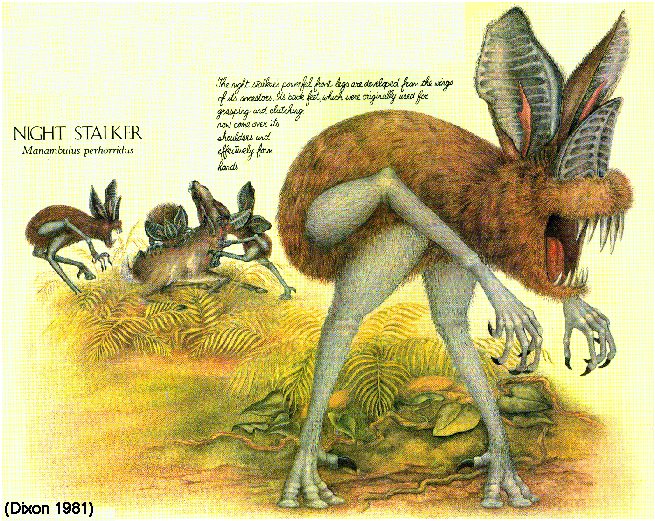
The first of these is something that I'm certain has been known for centuries by Latin American cattlemen, but has only now been properly analyzed by zoologists. It is the fact that vampire bats run. As you know, most bats are incredibly bad at moving around on the ground; a pained sort of shuffle seems to be the best they can manage. But not vampire bats. Specifically, the common vampire bat (Desmodus rotundus) is quite agile on the ground. This ties to their feeding strategy, which, contrary to filmic visions of sanguinophilous chiropterans flying directly for the jugular, involves creeping along the ground, stalking their prey. They often go for the extremities, sneaking up along the ground and feeding on the leg or foot of a large mammal. But if the blood heist falls through, they can book it out of there by running and jumping. Apparently, vampire bats may be too bloated with blood after a big meal to take off and just fly away from the ground, so they will launch themselves into the air to get a start on their skyward escape. The power with which these guys run is amazing: they honestly truck. Don't believe me? Check out the video, put up as supplementary material to the recent Nature paper describing this behavior. I find it almost frighteningly reminiscent of Dougal Dixon's imagined Batavian "night stalkers" from his book After Man: A Zoology of the Future.
The second wacky animal activity comes from a group oft-lauded for their amazing mimetic ability, the cephalopods. This goes beyond mere camouflage. Although octopodes and cuttlefish are masters of changing the color and even texture of their skin to match their surroundings, several species take things a step further. There is of course the Indo-Pacific mimic octopus, which is able to mimic an entire bestiary of poisonous marine creatures by adopting various body postures and swimming styles. And now, there's an algal mimic which looks remarkably like a loose chunk of weed hovering along the substrate. What is remarkable is not what it mimics, but how it does it. Instead of jetting about like most self-respecting cephalopods, or crawling across the ground as octopodes are wont to do, it runs bipedally. While it is further testament to the endless ingenuity of nature, you must also admit that it looks goofy as all heck. It's like a low-rent Ultraman villain, really.
Today I thought I'd share some awesome, "gee whiz" discoveries in the world of animal locomotion.
The first of these is something that I'm certain has been known for centuries by Latin American cattlemen, but has only now been properly analyzed by zoologists. It is the fact that vampire bats run. As you know, most bats are incredibly bad at moving around on the ground; a pained sort of shuffle seems to be the best they can manage. But not vampire bats. Specifically, the common vampire bat (Desmodus rotundus) is quite agile on the ground. This ties to their feeding strategy, which, contrary to filmic visions of sanguinophilous chiropterans flying directly for the jugular, involves creeping along the ground, stalking their prey. They often go for the extremities, sneaking up along the ground and feeding on the leg or foot of a large mammal. But if the blood heist falls through, they can book it out of there by running and jumping. Apparently, vampire bats may be too bloated with blood after a big meal to take off and just fly away from the ground, so they will launch themselves into the air to get a start on their skyward escape. The power with which these guys run is amazing: they honestly truck. Don't believe me? Check out the video, put up as supplementary material to the recent Nature paper describing this behavior. I find it almost frighteningly reminiscent of Dougal Dixon's imagined Batavian "night stalkers" from his book After Man: A Zoology of the Future.
The second wacky animal activity comes from a group oft-lauded for their amazing mimetic ability, the cephalopods. This goes beyond mere camouflage. Although octopodes and cuttlefish are masters of changing the color and even texture of their skin to match their surroundings, several species take things a step further. There is of course the Indo-Pacific mimic octopus, which is able to mimic an entire bestiary of poisonous marine creatures by adopting various body postures and swimming styles. And now, there's an algal mimic which looks remarkably like a loose chunk of weed hovering along the substrate. What is remarkable is not what it mimics, but how it does it. Instead of jetting about like most self-respecting cephalopods, or crawling across the ground as octopodes are wont to do, it runs bipedally. While it is further testament to the endless ingenuity of nature, you must also admit that it looks goofy as all heck. It's like a low-rent Ultraman villain, really.
Comments:
Post a Comment
